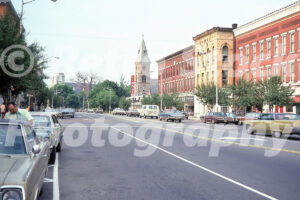
State Street, Springfield, MA 1960s
$20.00
Instant royalty-free download — no watermark.
Purchase includes a premium JPG file (3000–4000px on the longest edge), ideal for high-quality prints, publications, websites, décor, creative projects, and more. Once your order is complete, your download link will appear immediately at checkout – no waiting.
- Buy 5 or more photos and get a 15% discount
This colourful street scene captures State Street during a quieter, more confident era of mid-20th-century America. The view looks toward downtown, where a clocktower rises faintly in the distance, framed by leafy trees and low brick buildings.
On the right is the Varsity Spa, its neon sign shaped like a leaping dolphin or seal—a classic piece of roadside visual flair. Its window advertises breakfast, lunch, and dinner, while ribbed glass blocks along the façade give it that unmistakable post-war style. Just ahead, a cluster of signs outlines the rules of the road: one-hour parking from 8 AM to 6 PM, and no parking after 1 AM—likely enforced for street cleaning or nightlife activity.
Across the street, a billboard advertises the Valley Cinema and Valley Sound Corp, featuring family-friendly movie titles and promotions. The theatre itself sits just behind it, with bold lettering above the marquee. Next door, a barber shop sign promises professional grooming with a simple “TO TRIM” sign—straightforward and very much of its time.
To the left, grand Victorian houses sit back from the road, shaded by mature trees, hinting at one of Springfield’s older residential districts. Among them is a sign for Upland Restaurant, suggesting a thriving neighbourhood where shops, cafés, and longtime diners mingled with longtime residents.
Traffic is light but classic: on the left, a large late-1950s Mercury or Ford sedan cruises past, long and low with tailfins and a chrome-trimmed rear quarter panel. Farther down the street, a mix of compact and full-size American cars fill the lanes—Chevrolets, Fords and possibly a Studebaker or Plymouth—capturing the automotive diversity just before styling turned boxier in the late ’60s.
Near the centre of the image stands a sign for Concord Terrace and the First Presbyterian Church, while another placard advertises Russell Funeral Home—the sort of long-established local businesses that anchored small American cities for generations.
Everything here feels lived-in but orderly: painted curbs, clean pavements, neat hedges and shopfronts maintained just enough to keep pace with modern tastes. It’s a streetscape transitioning from the post-war boom to the suburban era, yet still full of walkable neighbourhood charm—small businesses, mixed housing, local services, and the hum of everyday life.