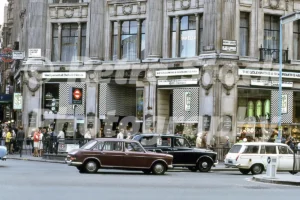
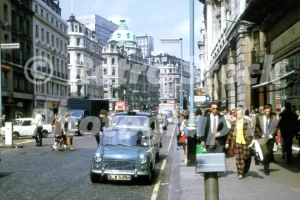
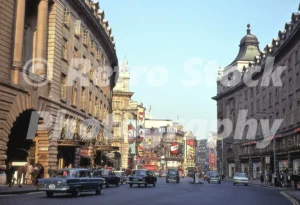
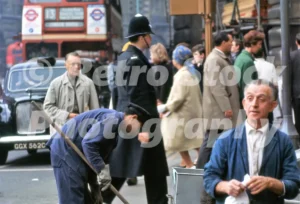
Regent Street, London 1987
$20.00
Instant royalty-free digital download. No watermark. You will receive a JPG image of between 3000 and 4000 pixels on the longest side. Perfect for prints, books, media, creative projects, and more. The download link will appear in the checkout after successful purchase.
- Buy 5 or more photos and get a 15% discount
The MCW Metrobus was one of the most successful double-decker buses introduced in Britain during the late 20th century. Designed and built by Metro-Cammell Weymann (MCW), the Metrobus served as a modern, reliable alternative to the aging fleets of the 1970s, and became a mainstay on the streets of major UK cities?most notably London, Birmingham, and West Yorkshire.
Background and Development
By the mid-1970s, British bus operators?particularly in large cities?needed to replace aging fleets of Routemasters, Daimlers, and other older models. Responding to the demand, MCW developed the Metrobus, a fully-integrated double-decker bus that combined chassis and bodywork into a single product.
Production began in 1977, and the Metrobus was positioned as a modern successor to traditional half-cab buses. The first prototype appeared in 1977, with full production starting in 1978.
Key Design Features
The Metrobus was built with both operator efficiency and passenger comfort in mind. Key features included:
-
Integral construction: Like the Leyland National, the Metrobus used an integrated chassis-body design for greater strength and simpler production.
-
A boxy, angular design with large windows and a flat front end.
-
Available in both single-door and dual-door configurations to suit high-frequency urban routes.
-
Front entrance with driver-only operation, reducing the need for conductors.
-
Most models were powered by Gardner or Cummins diesel engines, with Voith or ZF automatic gearboxes.
-
Offered in both 2-axle and 3-axle (tri-axle) versions, the latter mainly for export and high-capacity routes.
The vehicle?s rugged design made it particularly well-suited for intensive urban use and high passenger volumes.
Service in London and Beyond
The largest single operator of the Metrobus was London Transport, which eventually purchased over 1,400 units, primarily for use on busy routes across the capital. Their Metrobus fleet was classified into several classes (M, MT, and MD), and operated from the early 1980s into the early 2000s.
Elsewhere, West Midlands PTE (later West Midlands Travel) became the second-largest user, running hundreds of Metrobuses in and around Birmingham, Coventry, and Wolverhampton.
Other notable operators included:
-
South Yorkshire Transport
-
West Yorkshire PTE
-
Greater Manchester Transport
-
Nottingham City Transport
-
Tyne and Wear PTE
The Metrobus was also exported, with small fleets operating in places like Hong Kong, Singapore, and South Africa?where the tri-axle versions proved particularly useful on long, crowded routes.
Variants and Later Years
There were three main production marks of the Metrobus:
-
Mark I (1977?1981): Early design with more angular bodywork and Gardner engines.
-
Mark II (1981?1986): Improved front design, better corrosion resistance, and more engine options.
-
Mark IIA/Mark III: Slightly updated versions with air suspension and other refinements, used into the early 1990s.
Production ended in 1989 when MCW closed down, and rights to the design were not taken up by any other manufacturer. By then, newer low-floor buses such as the Dennis Trident and Volvo B7TL were starting to dominate the market.
Withdrawal and Preservation
The Metrobus saw front-line service well into the 2000s, especially in smaller towns and independent fleets. In London, the final Metrobus operated in 2006, ending nearly three decades of service.
Dozens of Metrobuses have been preserved, many still operational at rallies, heritage events, and private collections. Their angular styling and unique engine note continue to evoke strong memories for those who used them daily.
Conclusion: A Backbone of Urban Bus Travel
The MCW Metrobus was not flashy or groundbreaking in a stylistic sense?but it was solid, efficient, and well suited to the demands of late 20th-century urban Britain. Its longevity and widespread adoption made it a key figure in the transition from crewed to one-person-operated buses, and from older body-on-chassis types to integrated bus designs.
| Photo options | Digital Download |
|---|