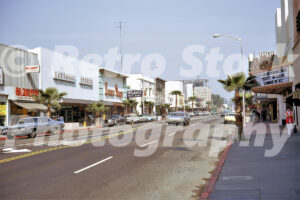
E Street, Downtown San Bernardino 1972
$20.00
Instant royalty-free download — no watermark.
Purchase includes a premium JPG file (3000–4000px on the longest edge), ideal for high-quality prints, publications, websites, décor, creative projects, and more. Once your order is complete, your download link will appear immediately at checkout – no waiting.
- Buy 5 or more photos and get a 15% discount
This photograph captures a lively moment along E Street, once the commercial heart of San Bernardino, during the early 1970s. At the time, this stretch between 4th and 6th Streets was still a thriving retail and social corridor, home to banks, clothing stores, restaurants, beauty salons, loan offices and small independent businesses that served both locals and visitors. Before the arrival of suburban malls and freeway-oriented development, this was the place where people came to shop, meet friends, buy shoes, cash a paycheck or simply watch the world go by.
On the right, the striking gold-screened façade belongs to the headquarters of First Federal Savings & Loan, located at 535 E Street—one of the city’s most modern commercial buildings at the time. Its bold mid-century design contrasts with the older storefronts beside it, reflecting the architectural transition happening in many Western cities as new glass, aluminum and concrete replaced prewar ornament and brick.
Further north, a white mid-rise with a small decorative cupola rises above the street. Buildings like this—structures with modest vertical ambition and a touch of ornament—were reminders of San Bernardino’s earlier prosperity, when the railroad, military presence and Route 66 tourism made the city a regional hub. Just beyond this point, the once-prominent California Hotel stood at the corner of 5th and E, serving travelers, convention guests and business people until its decline and eventual demolition in the 1980s.
At street level, the signs tell the story of everyday life. Gilbert’s appears on the left, while Tuxie’s, a well-known Inland Empire hamburger chain of the era, stands further ahead—popular with teenagers, late-night drivers and the Route 66 cruising crowd. Small family-run shops, including beauty salons, clothing stores and loan offices, fill the gaps in between. Their storefronts, awnings and neon signs reflected a time when downtown commerce depended on foot traffic rather than freeways.
The people crossing the street add a slice of ordinary life: a woman in a boldly fashionable red dress, a man with a jacket slung over his shoulder and another pedestrian walking alone. The pace feels relaxed. The cars—full-sized American sedans, two-tone coupes and daily drivers—fill the scene with the unmistakable look of early-1970s California.
Within a decade, much of this corridor would change dramatically as downtown retail declined, regional malls rose to prominence and redevelopment reshaped the historic business district. But in this moment, E Street still feels complete: active, balanced, and unmistakably the civic and social backbone of San Bernardino.